KiBa-Pro research project launches — Batalyse builds the data backbone for LFP cell manufacturing
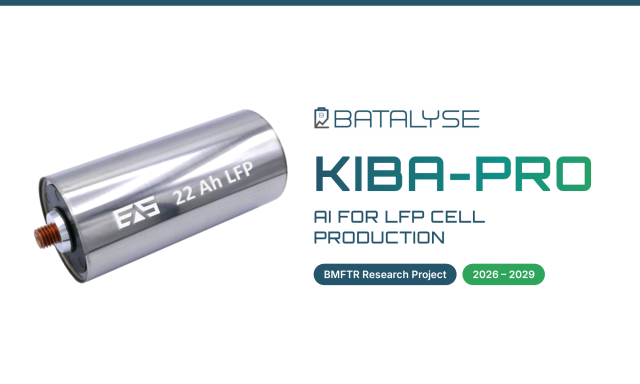
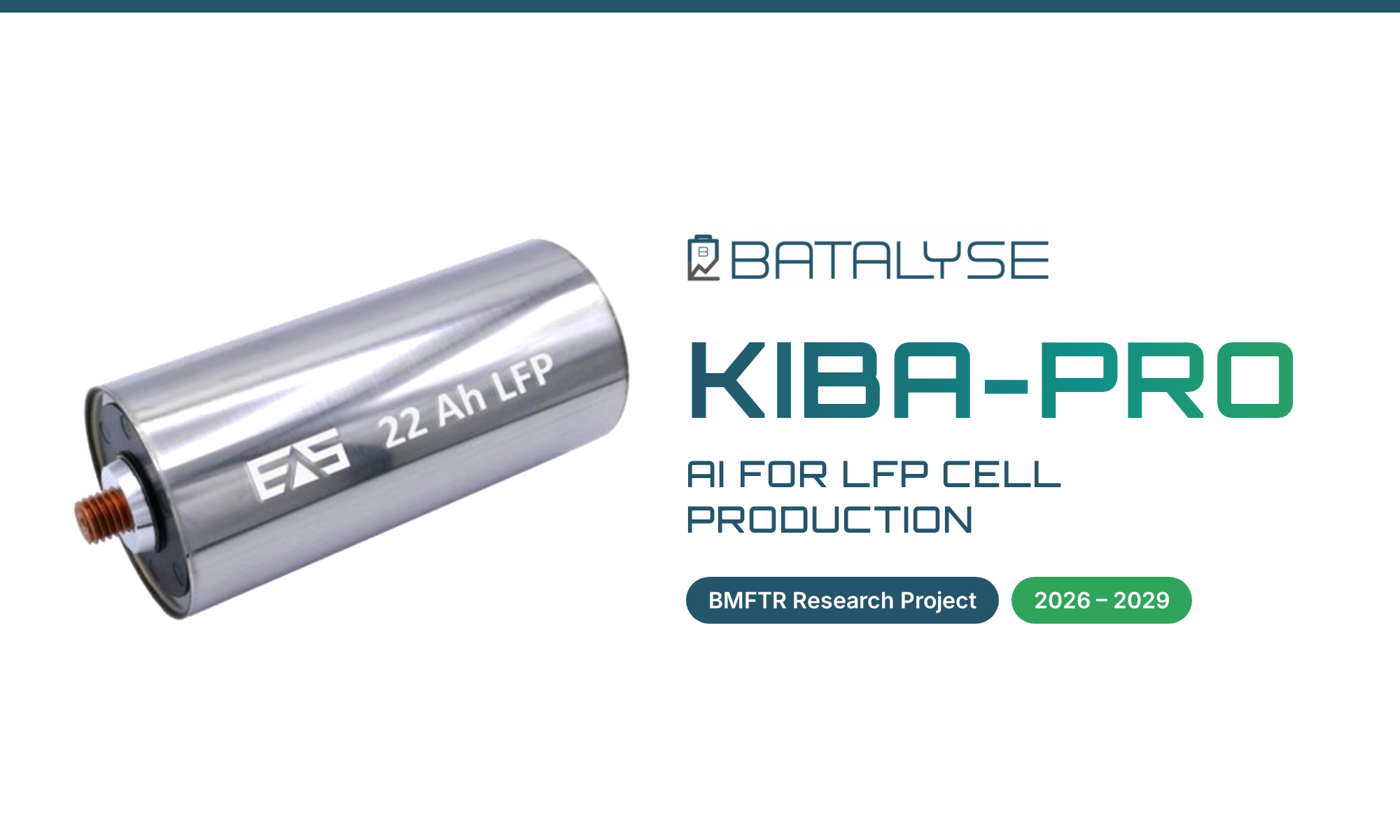
With the launch of the collaborative project KiBa-Pro (“AI-based cell production: digitalisation and modelling”), a consortium of industry and research is developing new ways to improve the manufacturing of lithium iron phosphate (LFP) cells through digitalisation and artificial intelligence. Under the coordination of EAS Batteries GmbH, research institutes and industrial partners are working together to optimise production processes on a data-driven basis, raise cell quality and extend cell service life. The project runs from July 2026 to June 2029.
Batalyse GmbH leads the project’s central work package on digitalisation and data infrastructure — and is responsible for turning a real production line into a coherent, analysable data set: from the mixing process through to the digital battery passport of every single cell.
From production line to data source
In the first step, the EAS manufacturing line in Nordhausen is comprehensively digitalised. Production, material and quality data are systematically captured through additional sensors and modern interfaces and brought together in a central data infrastructure. This creates a continuous data foundation along the entire production process — the factory itself becomes the data source for intelligent optimisation.
On this basis, the consortium develops a virtual LFP cell. Modern AI methods analyse large data volumes to reveal the relationships between production parameters and later cell properties. Factors such as coating thickness, porosity, material throughput or temperature profiles can be assessed in a targeted way, with the goal of predicting effects on service life, capacity and performance before real production trials are run. Optimisations can then be simulated and evaluated virtually first — reducing development effort and scrap rates, shortening optimisation cycles and enabling error sources to be identified early.
The consortium is targeting an increase in cell service life of at least 10 % and in production yield and process stability of at least 15 %.
What Batalyse contributes
1. Digitalising the production process
Together with EAS and the associated partner Omron, Batalyse carries out a detailed process analysis of the entire LFP manufacturing chain — mixing, coating, calendering, electrode quality, cell assembly and formation — to identify every process parameter that influences cell quality.
For each parameter, suitable interfaces to the production equipment are developed. Modern machines are connected via digital interfaces such as OPC UA; for older systems, offline data sets are imported and mapped. Batalyse implements unique identifiers for gapless cell-level traceability: offline data is matched via file names and headers, online data via automatically captured timestamps. All raw data is validated, cleaned and transferred into a standardised, FAIR-compliant format, with complete metadata — timestamps, machine parameters, batch information and quality indicators — assigned to every record.
A real-time dashboard gives EAS live visibility of critical process variables such as coating thickness, drying temperatures, electrode compaction and formation profiles, including first descriptive analyses of process stability. After each production campaign, an automated KPI reporting system generates statistical analyses of product quality and process stability, comparisons between batches and visualisations of quality development over time.
2. A central, integrated data infrastructure
Batalyse hosts and operates the KiBa-Pro project server and builds the shared data platform for the consortium. Technically, this rests on a PostgreSQL backend that stores structured and semi-structured measurement data alongside arbitrary binary files such as images or proprietary instrument formats.
KiBa-Pro realises, for the first time, a bidirectional coupling between the Batalyse software and Kadi4Mat: a local Kadi4Mat instance at EAS is synchronised with the externally hosted Batalyse project server via REST APIs. Raw data is transferred from Kadi4Mat to Batalyse, evaluated automatically, and the results written back. Additional interfaces give direct access to Python scripts, the AI models developed by RWTH Aachen, and visualisation tools.
A role-based access concept allows differentiated permissions for each project partner so that commercially sensitive production information stays protected. Automated data pipelines monitor directories and API endpoints, detect new data sets, run validation checks, trigger evaluation routines and store the results in structured form.
3. Standardised data models and robust parsing
Batalyse defines standardised data models — drawing on established battery research standards such as BattInfo as well as project-specific schemas — covering three layers:
- a cell data model describing format, nominal capacity, chemistry, weight, dimensions and production information including batch numbers and material batches;
- a production data model that hierarchically structures all process parameters along the manufacturing chain, mapped to process steps, machines and timestamps;
- a test data model for electrochemical test protocols, measured values and derived parameters with full metadata.
Robust parsing routines read raw files from cyclers, impedance spectrometers and production equipment, extract the relevant information and transfer it into these models — designed to tolerate format variations and to catch errors rather than fail silently. Relational links via common cell IDs make it possible to query production, test and simulation data together.
4. Automated evaluation of electrochemical data
Batalyse adapts and extends its evaluation modules so that test data from any cycler or test system used in the project, in any file structure, can be processed automatically: capacity analysis, impedance analysis (EIS), differential voltage analysis (DVA), temperature analysis and formation analysis.
A particular focus is the direct comparison of experimental and simulated data: dedicated visualisation tools overlay measured and modelled curves and quantify the deviations, feeding straight back into model validation and improvement. Statistical routines assess reproducibility and scatter within cell batches using histograms, box plots and statistical metrics. A dedicated workstation, permanently connected to the project database, runs these evaluations event-driven — triggered either manually by a project partner or automatically when new data arrives.
5. Digital supply chain management
The existing supplier management is extended with graphical supply chain visualisation, assignment of suppliers to the materials used, and flagging of critical raw materials such as lithium, nickel and cobalt, complemented by a risk scoring approach. These functions support compliance documentation under the EU Battery Regulation.
6. Digital battery passport at cell level — including CO₂ footprint
Every cell produced receives a unique QR code. When it is scanned, the product passport is generated dynamically as a PDF from whatever data is present in the system at that moment, using configurable templates — so when new data sets are added later, for example from ageing tests or subsequent characterisation, they appear automatically in the updated passport.
The external view contains product information, safety notes, sustainability data, performance indicators and recycling information. The protected internal view links detailed production parameters, material batches, quality control results, electrochemical characterisation, test data and the comparison against simulation results, including deviations from target values.
A central part of the sustainability data is supplied by an automated carbon footprint module, which calculates greenhouse gas emissions along the entire production chain: material flows with their emission factors, energy consumption based on the site-specific energy mix, transport emissions, production scrap and recycled material content. Emissions are aggregated across the process chain and broken down to the individual cell, so that each passport carries the actual footprint of that cell rather than an averaged figure — with graphical visualisation of the contribution of each component and process step. Changes over time and across production batches are tracked, allowing the CO₂ reduction achieved through the process optimisations to be quantified.
Where the EU Battery Regulation addresses systems from 2 kWh upwards, the Batalyse approach deliberately targets research, development and pilot production at single-cell resolution — the level at which research institutes and mid-sized manufacturers actually need traceability.
7. Infrastructure for correlation analysis
Batalyse provides the technical basis for the statistical work that closes the loop: data integration and cleaning across common identifiers, handling of missing values and outliers, normalisation, and extraction of meaningful features such as ageing rates, capacity fade, impedance changes or deviations between simulated and measured values. The scientific partners run the analyses and assess their physical interpretability; the resulting optimisation recommendations flow back into the next production batches.
Building on existing work
The work builds on Batalyse’s earlier “Automate” project (2023–2025, funded by the state of Baden-Württemberg), in which a first prototype for fuel cells, electrolysis and redox flow batteries was developed.
“Battery research generates enormous amounts of data — but most of it never becomes knowledge, because production data, test results and simulations live in separate worlds. In KiBa-Pro we bring them into one system and follow them down to the individual cell. That is what makes it possible to say with confidence which process parameter actually determined the lifetime of a given cell.”
— Dr. Markus Hagen, Managing Director, Batalyse GmbH
Why it matters for European manufacturers
KiBa-Pro goes beyond the state of the art through its closed-loop approach between real industrial LFP production, physico-chemical models and data-driven optimisation. For the first time, the influence of production parameters on end-of-life cell performance is systematised — while the scalable Kadi4Mat/Batalyse ecosystem creates the basis for EU battery passport compliance and a technologically sovereign data infrastructure for European mid-sized manufacturers.
The functions developed in the project will be integrated into the existing Batalyse products Collect, Data Analysis, Mind and EIS Analyzer, making them available to battery producers, material and component manufacturers and research organisations beyond the project.
KiBa-Pro is funded by the German Federal Ministry of Research, Technology and Space (BMFTR) under grant number 03XPB069, with Projektträger Jülich (PtJ) as the project management agency.
Project partners
- EAS Batteries GmbH (coordination)
- RWTH Aachen University, Institute for Power Electronics and Electrical Drives (ISEA)
- Karlsruhe Institute of Technology (KIT), Institute of Nanotechnology (INT)
- Batalyse GmbH
- Omron Europe B.V. (associated partner)
Founded in 2021 as a spin-off of the Fraunhofer Institute for Chemical Technology (ICT), Batalyse develops software for data management and the automated evaluation of electrochemical storage and conversion systems — from research and quality assurance through to production. The modules Collect, Data Analysis, Mind and EIS Analyzer work independently or in combination.
Questions about KiBa-Pro?
Batalyse GmbH | Dr. Markus Hagen
+49 176 244 716 88 | markus@batalyse.com | www.batalyse.com